
National Lightning Safety Awareness Week (June 19 – 25)
The National Lightning Safety Council was established to promote lightning safety education and awareness. The Council recognizes National Lightning Safety Awareness Week as a unique opportunity to provide the public with safety information about lightning. We also encourage you to visit NOAA’s comprehensive lightning safety web site to learn more about lightning and lightning safety.
What You Might Not Know About Lightning
- All thunderstorms produce lightning and are dangerous.
- Lightning often strikes outside the area of heavy rain and may strike as far as 10 miles from any rainfall.
- If you can hear thunder, you are in danger. Even if the skies are blue, if you hear thunder, lightning is close enough to pose an immediate threat.
Avoid The Lightning Threat
- Postpone activities if thunderstorms are in the forecast.
- Monitor the weather, watch for signs of a developing or approaching thunderstorm such as towering clouds, darkening skies, or flashes of lightning.
- If you hear thunder, don’t use a corded phone. Lighting can travel through the phone lines.
- Keep away from electrical equipment and plumbing. Lightning will travel through the wiring and plumbing if your building is struck.
If someone is Struck by Lightning
- Call for Help. Call 9-1-1
- Give first aid. Begin CPR if you are trained
- Use an Automatic External Defibrillator if one is available.
- Don’t be a victim. If possible, move the victim to a safer place. Lightning CAN strike the same place twice.
For more information on Lightning Safety visit: http://lightningsafetycouncil.org/
Summer and Extreme Heat
There is hot, and then there is HOT! Extreme heat is a period of high heat and humidity with temperatures above 90 degrees for at least two to three days. In extreme heat your body works extra hard to maintain a normal temperature, which can lead to death. According to ready.gov, extreme heat is responsible for the highest number of annual deaths among all weather-related hazards.
It is NEVER safe to leave a toddler, disabled person or pet locked in a car. 910 children have died due to Pediatric Vehicular Heatstroke since 1998, according to nhtsa.gov.
The majority of hot car deaths – 53%- happen because someone forgets a child in a car. In 2019 (just three years ago) we saw the highest number of deaths, 53, because children were forgotten.
Tips for Adults with Kids in the Car
According to the National Highway Traffic Safety Administration, they suggest the following tips:
- Check for Baby. Parents and caregivers, get in the habit of always looking inside your car before locking the doors.
- Everyone should keep their car locked. 26% of heat related car deaths, happen because a child got stuck in an unattended vehicle.
- The temperature inside a car can reach over 115 degrees when the outside temperature is just 70 degrees.
- Never leave a child alone in a parked car, even with the windows rolled down or the air conditioning on. A child’s body temperature can rise three to five times faster than an adult’s.
- If you see a child alone in a vehicle, make sure the child is ok and responsive. If not, call 911 immediately.
- If the child appears to be okay, attempt to locate the parents; if at a public place, have the facility page the owner over an intercom system.
- If the child is not responsive and appears to be in distress, attempt to get into the car to assist the child-even if that means breaking a window. Many states have a “Good Samaritan” laws
For more information on Heat Safety visit: https://www.ready.gov/heat
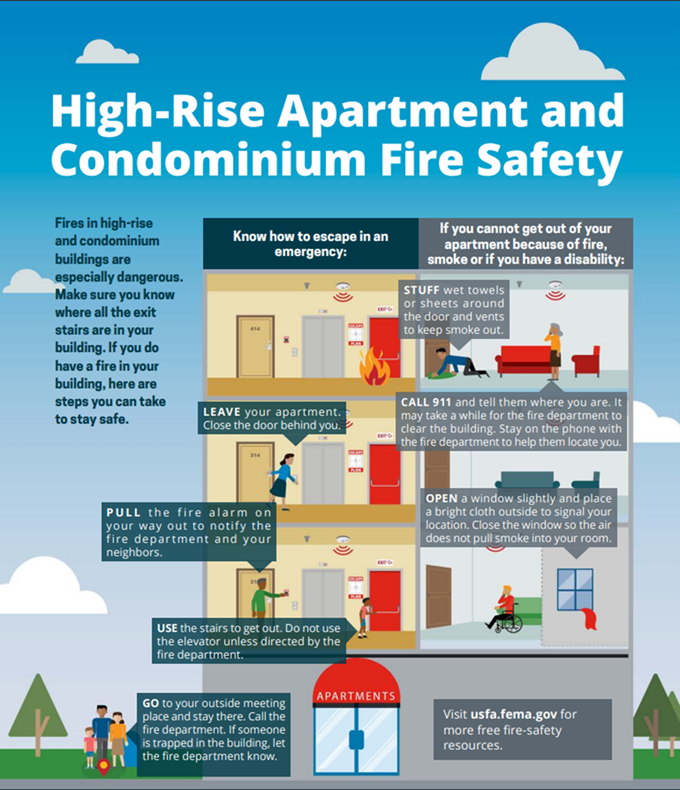
High-Rise Fire Safety
Those who live in a high-rise building, need to be familiar with their building layout and the design of the building’s safety systems. FEMA outlines how you can be safe in a high-rise building in the image below.
Have an idea, question, story, or feedback you’d like to share? Send an email to CrisisMgmt@intactinsurance.com
SafetyFIRST! is for internal use and informational purposes only. Questions may be directed to CrisisMgmt@intactinsurance.com